Tuesday, November 6, 2012

A Call for Peace


"Those who are crazy enough to think that they can change the world...
are the ones that do." -Unknown 


We must not only understand our world, we must respect it. There is no greater existence than one of peace, and love. It is not a farfetched or radical idea to believe world peace possible. I have seen it present and active in communities, both human and nonhuman, everywhere I visit. It may be a slow beginning, but as long as we, the collective beings of planet Earth, trek on into the often uncertain future with a spark of hope and embers burning with fiery determination, nothing but good will come from us and our world.

The beings we share the planet with are not that different from us. Emotional, vibrant, and resourceful, the other species we live alongside are treated to the same sunsets and battered by the same storms as we. We, the collective beings of planet Earth, are all consciously moving through the marvelous experience of existence on this planet, and are subject to the same primal government of nature. Harmony exists, if not everywhere, than in most places, and human beings have disrupted much of this harmony and exploited many of the beings and places that thrived in previously harmonious areas.

Our job, our mission, our place, should be peace. A message of respect, love, kindness, and empowerment should come from our hearts and spread to everyone we encounter. We should not discriminate, hate, or ridicule. At our very worst we should be at least attentive. Aware. Paying attention to the drumming of life around and within us, and determined to preserve its current beauty and inspire a grander future.


 "The opposite of life is not death, but indifference." - Elie Wiesel 

We do not exist solitarily on Earth, nor do any other living beings upon soil or within sea. We are all interconnected and we are all citizens of a greater and more blindingly beautiful web of energy that can be described as no less than
L I F E. Through our very cores runs the capacity for a peaceful tomorrow, and this flows within and around all corners of our world. By awakening to the wonderful yet simple truth that Earth is a wildly diverse planet that is very much alive on every square centimeter of its sphere, we will realize that it is our duty to return what we have stolen from our past, present, and future: peace.
By making it both our personal and collective mission to inspire positive change and hope for our world, we may advance and enrich ourselves and our neighbors.

Robert Kennedy once said,
"Each time a man stands up for an ideal, or acts to improve the lot of others, or strikes out against injustice, he sends forth a tiny ripple of hope, and crossing each other from a million different centers of energy and daring those ripples build a current which can sweep down the mightiest walls of oppression and resistance."


By speaking our mind and advocating for the improvement of life for all beings, we are each creating a ripple in the ocean of space&time, and our ripples intersect and combine to create great waves of change. 

The Dalai Lama tells us,
"It is not enough to be compassionate. You must act. There are two aspects to action. One is to overcome the distortions and afflictions of your own mind, that is, in terms of calming and eventually dispelling anger. This is action out of compassion. The other is more social, more public. When something needs to be done in the world to rectify the wrongs, if one is really concerned with benefitting others, one needs to be engaged, involved." 

We MUST act. We MUST speak out. We MUST use our VOICE for CHANGE! Positive change, for us, our environment, and every single living being who is on Planet Earth. "What you do makes a difference,and you have to decide what kind of difference you want to make" one of my personal heroes  Jane Goodall says. We are just a dot on the map, a star in the sky, a drop in the sea. But we affect all the other dots, stars, and drops around us, and they the ones around themselves, and so on...if we have such influence on the world around us, shouldn't we strive for positivity and healthy change?

Shouldn't we want to improve our world, not degrade it and its inhabitants?


As beings of peace, we will make Earth a place of hope, not destruction.
We WILL prevail: for as long as we tread lightly and proudly on the path to a peaceful world, we will greet tomorrow’s sun with greater joy than this morning’s, with the knowledge that its shining rays are rising on a better day than the last. 


~Peace always,
Kristina ~
✌Ⓥ☮


Sunday, September 23, 2012

Autumn's First Kiss

-->
            This evening I observed a flock of foraging Blackpoll warblers as they chipped with seeping voices amid the leaves. A bold Cape May warbler spiraled down to the grass in pursuit of an insect, an autumn leaf twirling from its tree. He dipped lightning-quick back into the branches as a sprightly bunch of Ruby-crowned Kinglets occupied the hedge line. They were quite fearless and came very close, looking at me with round, blank stares.
            A young male Common Yellowthroat sulked in the dead twigs below the kinglets, his yellow breast and throat glowing amid the darkness. His robust form dipped up and down with his olive back and black mask gently blending with the brush.
            A House Wren sneaked by in the background, careful to only show himself a few times before flitting down into the lower bushes, hidden once more.
            White-tails, with their grace and attention, mingled in the half-light of dusk by the treeline, their stares heavy on my consciousness.
            Silently overhead flew a Great Egret, washed peachy rose as he headed into the sunset.

A brilliantly vibrant sunset graced the sky and cast a soft early-autumn glow as a gently crisp breeze whispered through my hair. Standing facing a field where the sky opened up and the clouds stretched long and wide, their sunlit red underbellies giving them definition, I stretched out my arms and sighed. As I took in the cooling evening air, a breath of autumn filled my lungs. The first moment of fall. The first kiss from the most wonderful time of year.


~Peace always,
Kristina~

Thursday, September 6, 2012

The Sea, the Shore, and Me

If ever for a moment I forget to love the sea, 
I have forgotten to love the world that has shaped and crafted me.


I have always been drawn to the ocean. Its rolling tides, the gentle lulling rush of waves as they reach the shore, the faraway endless horizon, the biodiversity concealed just under the surface. Gulls and terns patrol the skies, shorebirds prod the sands, pelicans are sentinels on the docks. Dolphins frequent the currents, whales appear amid monotonous waves, seals rest placidly on the coast...


My first love were the cetaceans, and consequently, the sea. As a younger child I was enthralled by the mystic dolphins and mysterious whales, their sleek bodies and quick minds incomprehensibly fascinating. These peoples of the waters, the tribes of the oceans, grace the depths with consciousness unparalleled (I remain as passionate about them to this day).

The Mysticetes (baleen whales) are such beautiful citizens of Earth, their colossal bodies paired with striking physical and mental awareness. In the St. Lawrence river in Quebec, Canada I was gifted with the brief yet startling presence of a Minke whale ( Balaenoptera arctorostrata ) who appeared right beside the boat. Words fail to relate the divinity of this being and his grace. The encounter was too brief for a photograph yet lasted just long enough to capture a mental image of this tiny rorqual.

Off Cape May, New Jersey, far into the open Atlantic, a massive yet careful Humpback Whale ( Megaptera novaeangliae ) surfaced suddenly, just yards from the boat. Her great nostrils expelled old air and sucked in a new breath. Her tail was closest and it milled just under the surface, displacing such large amounts of water with the slightest movement. Her long wings of pectoral fins were visible through the waves and this was the most striking sight to me- being able to see this defining characteristic of her species, almost like a peek at something that was supposed to be hidden beneath the surface.


Bottlenose dolphins ( Tursiops truncatus )in the Banana River lagoon in Cocoa Beach, Florida, were so inquisitive and energetic as they sprinted round the small boat and the nearby docks. Youngsters leapt from the water alongside the raised tails and pectoral fins of their elders. Quickly, impossibly briefly, they surfaced and breathed and dove once again into the muddy lagoon. Small family associations were clear as the pod played about. They exuded a wonderful sense of togetherness.


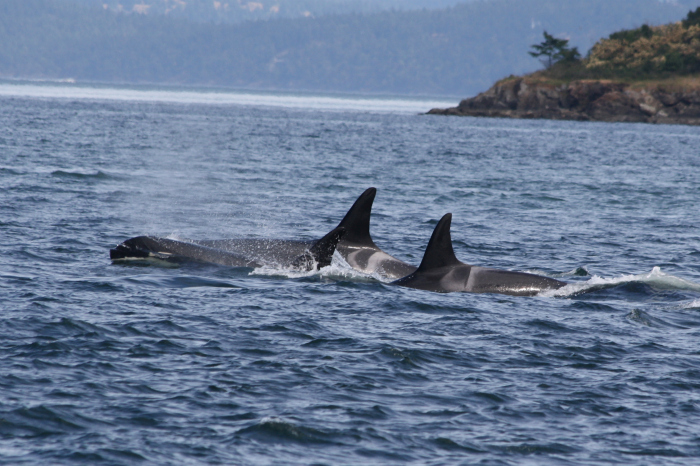
Orca ( Orcinus orca ) in the San Juan Islands were another sort of magic entirely. This endangered population of about 90 individuals resides in the Salish Sea off Washington's coast. Studied intensely since the late 70s, they are recognized by their researchers as individuals with names and alphanumerical designations. Target of numerous conservation efforts and recipients of worldwide fanfare, the Southern Residents, as they are known, are a unique population of their species and rich in heritage and culture. Their matriarchal society is superbly defined with much-respected female leaders. Granny, or J2 as she is known to biologists, is estimated to be 100 years old. Recently deceased K-pod matriarchs Georgia K11 and Lummi K7 were thought to be in their 70's when they passed.

L Pod members L109, L25, and L77

The mother-child bonds in Orca are especially strong, with both sons and daughters remaining with their mothers and siblings for their entire lives. Granny swims with a subgroup of J-pod which includes her grandchildren and great-grandchildren and, as of August 2012, her great-great grandchild. Simply put, Orca are remarkable. Their cultures evolve with similarity to humans' and their distinct linguistic dialects and phrases set even further parallels to humankind.


Needless to say, the Southern Residents occupy a dear place in my heart. I have unequaled adoration and respect for these beings of the island straits. I visited their home waters in 2009 and, to my utter delight, witnessed a 'superpod'; a gathering of all three resident pods (J, K, and L). I saw Granny and her son Ruffles J1 (may the currents rest his soul; he sadly passed in late 2010 in his 60's), along with many other much-loved members of the pods. Seeing Orca in their spectacular natural home only solidified my beliefs that all life should be left to live free, and not captive as many nonhumans are kept in parks, zoos, and aquariums worldwide.


The avian life dependent upon the oceans is diverse and wonderful. Terns are the fairies of the coasts and open waters, their slender wings and lithe bodies slicing through air and water.
Caspian Terns ( Sterna caspia ), the largest variety, I see often. Their rattling voices and strong wingbeats, their heavy scarlet bills and jet black caps...they are a sturdy but elegant bird.

Black Terns ( Chlidonias niger ) are zippy, their silvery wings flashing as their black bodies shoot through the skies over marshes and mudflats. They have a distinct buoyant flight that is joyful to watch. Royal Terns ( Sterna maxima )are larger and sport an orange bill and a scruffy black crown. In Florida on Cocoa Beach I saw these charismatic birds up close, and enjoyed their almost comedic character as they stood on short little legs.


In Cape May I saw many Least Terns ( Sterna antillarum )and Forster's Terns ( Sterna forsteri ); they are small and yet so skilled at fishing.  I watched as adults hovered repeatedly and plunged without warning into the waves; I was astounded by their graceful intensity.


Later I was able to visit a Least Tern nesting site where these state-endangered birds fed chicks on the light tan sand. Mated pairs rotated shifts of bringing tiny fish in for each other and their children, holding the food delicately in their pale orange bills.


Nesting alongside the Least Terns were Piping Plovers ( Charadrias melodus ), petite shorebirds widely thought of as some of the cutest. Their subtle sandy plumage and pastel slate facial markings combine with large, dark eyes to form an arguably adorable bird. They scurried about, pausing every so often, picking at the sand for prey.


Back in Cocoa Beach were Sanderlings ( Calidris alba ), little sandpipers with pleasing grey and white feathers and thin black bills. They chased the surf on three-toed feet, quickly darting stray droplets. With them a few Willets ( Catoptrophorus semipalmatus ) searched for fish. These larger shorebirds had similar colours but longer necks, bills, and legs. When startled, they lifted off on surprisingly marked wings- dark chocolate brown with white wingbars through the primaries and secondaries.


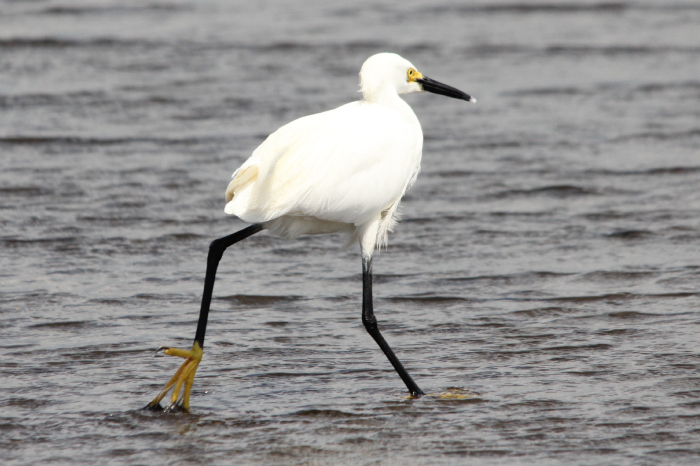
Also on stilt legs are the wading birds- herons, egrets, ibises, and their relatives. Florida was rich with all sorts of beautiful waders, including Little Blue Herons ( Egretta caerulea ), Snowy Egrets ( Egretta thula ), and Tricoloured Herons ( Egretta tricolor ). These elegant birds have snakelike necks and daggerlike bills designed for lancing fish and frogs. White Ibises ( Eudocimis albus ) and Limpkins ( Aramas gaurauna ) prefer snails, crayfish, and tiny crustaceans with their long but decurved bills with rounded tips.  Roseate Spoonbills ( Platalea ajaja ) are unique with their spoonlike wide tip to their bill, which they gently sweep side to side in the shallows for their prey.


Pelicans are curious birds; I love how they glide in militant formations over the coasts, long wings and bills distinct. They have a certain presence about them that is simultaneously comical and serious which I find intriguing. In Virginia this spring I had a special moment with a small group of Brown Pelicans ( Pelecanus occidentalis )as I ran alongside them on the beach as they swept low over the waters at early sunset.


With such diversity and majesty, it is difficult to pinpoint my favourite aspect of the oceans. Yet with a little thought and soul searching, the answer is obvious: I am in constant awe and reverence of the pure magic of the seas. I find a kinship with the beings who inhabit the waters and a lullaby in the lapping waves. As I write these words I am brimming with passion and wonderment; as eloquent as I like to think I am, I simply cannot adequately express how deeply inspired and guided I am by the seas and their residents. I believe one of my favourite poets, e.e. cummings, has found already the words:

"whatever we lose, like a you or a me
it's always ourselves we find in the sea"
-e.e. cummings, 'maggie and milly and molly and may'

~Peace always,
Kristina~